


From 1am Friday 23 July 2021, mandatory COVID-19 testing for freight and logistics operators will come into effect, along with changed requirements under the QLD Freight Protocol.
Mandatory testing will help to keep our essential drivers, their families, and the community safe from the spread of COVID-19.
The QLD Freight Protocol has been updated in response to changes in the Border Restrictions Direction (No. 28) and Queensland Border Declaration pass requirements (Freight and logistics). These updates will also come into effect from 1am Friday 23 July 2021.
Mandatory COVID-19 testing
Mandatory testing regimes will be in place for freight and logistics operators entering Queensland from QLD declared COVID-19 hotspots.
If you are asymptomatic and undertaking mandatory COVID-19 testing as a freight and logistics operator, you are not required to isolate while awaiting a test result.
If you are symptomatic or tested for any reason other than as a freight and logistics operator, you must continue to follow all relevant public health advice, including isolating until a negative test result is received and you are symptom-free.
*New* COVID-19 Affected Areas and testing
As defined in the updated QLD Freight Protocol, an Affected Area means the local government areas of Fairfield, Liverpool and Canterbury-Bankstown in New South Wales.
Evidence must be made available in order to enter Queensland.
COVID-19 hotspots and testing
Evidence of testing
COVID-19 testing locations
To support industry in maintaining mandatory testing the NHVR COVID-19 Support Map provides details of dedicated heavy vehicle driver testing sites across states and territories.
Queensland Government will continue to look at options that might be suitable for heavy vehicles and will provide further updates as necessary.
Freight and logistics operators can be tested at Queensland Health fever testing clinics.
Find a Queensland COVID-19 testing location.
Operators can show their ID card and valid Queensland Border Declaration Pass (FPass) to health workers when they arrive to be prioritised for testing. Costs may be incurred if operators go to a private testing facility.
Border declarations and passes
Travelling in and around Queensland without the necessary documentation will cost you $4,135. Queensland Police and TMR Transport Inspectors are actively monitoring Queensland border crossing locations.
The Queensland Border Declaration system is being updated, further information will be provided in the coming days.
Queensland Border Declaration Pass (FPass)
Example: A freight and logistics operator who will be travelling between an affected area and Queensland several times within a 14 day period will have to complete a new Queensland Border Declaration Pass (FPass) every time they plan to enter Queensland after being in an affected area.
Queensland Travel Declaration
Freight and logistics operators must adhere to the requirements of the QLD Freight Protocol when entering QLD, remaining vigilant and make every effort to limit your exposure.
Always keep records of close contacts, check in and out wherever you can, get a COVID-19 vaccination when it is available to you and wear a face mask.
Thank you for your continued efforts to keep freight moving safely and we will continue to keep you updated on the latest advice on Queensland Health requirements as they are released.
Importantly, support continues for those in the transport, freight and logistics industry as these are considered essential activities.
Further information
Whilst TMR is happy to assist with industry questions,134 COVID (134 268) has been set up to assist with fast responses to queries.
Further information about the Queensland border restrictions, including questions and answers, can be found on the border restrictions webpage.
For more information see Department of Transport and Main Roads Mandatory COVID-19 testing for freight and logistics operators.

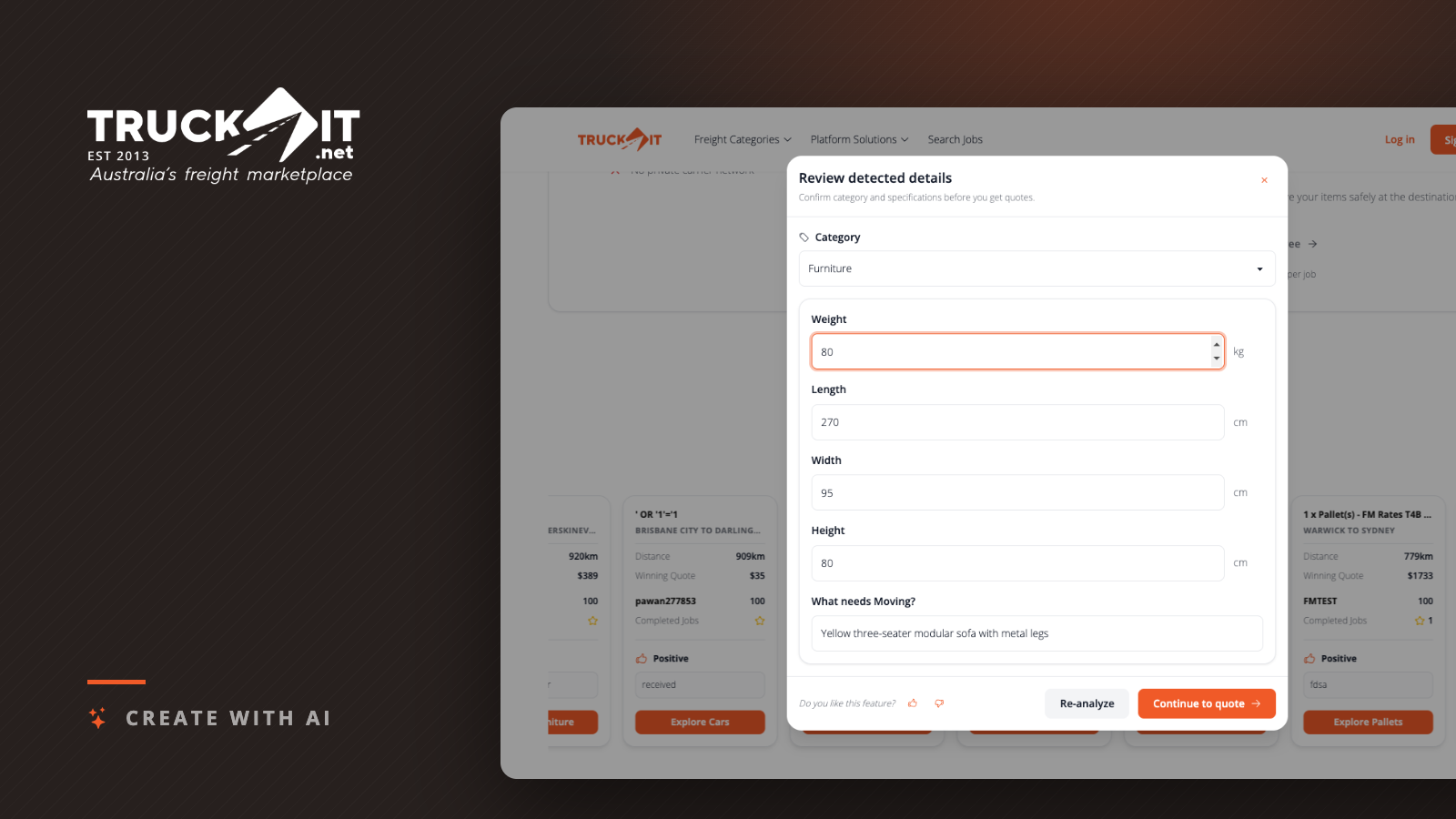
News · Product Update Your freight quote now starts with a photo Create with AI is live on Truckit. Photograph what you are moving and the listing fills itself in. TK Truckit Australia's freight marketplace 14th of September 2026 · 5 min read Take a photo of the thing you need moved. That is now enough to start a freight quote. Create with AI is live on Truckit. Upload a picture of your couch, your dresser or your pallet of stock, and Truckit reads the image, works out which freight category it belongs in, and estimates the weight and dimensions. […]
News · Managed Services Freight is the friction your business doesn’t need. Here’s how managed services remove it. Why more Australian businesses are handing their freight to a managed service, and what they get back. KD Kieran Dawkins Head of Managed Services · Truckit.net 18 July 2026 · 5 min read While most businesses can understand a freight rate card, a lot aren’t quite aware of the true freight costs to their business. Everything from the time it takes to procure and manage carriers, to increasing capacity at short notice, through to chasing ETAs, reconciling invoices, misaligned payment terms and […]

We’ve been busy building behind the scenes, and a wave of new features have just rolled out. Most of it points the same way: putting AI to work on the parts of freight that used to eat your time. Searching for jobs, writing your profile, matching the right provider to the right load. Here is what is live now, and what we are working on next. You can now find freight jobs just by asking Type "find container jobs within 100km of Maryborough" into the Search Jobs page, and Truckit knows exactly what you mean. No filters to set, no […]
