


Truckit.net is Australia's largest freight marketplace and as a marketplace, customers ultimately face a lot of choice when it comes to selecting a transport provider for their job.

Imagine you're a customer. You have received multiple quotes for your job, all are competitive on price and can deliver in a reasonable time frame. So how do you choose?
More times than not, the first place a customer will look is your Truckit profile. A good profile should read like the blurb of a book, informative yet concise and leaving customers wanting to finish the book (or job in this case).
You can edit your profile by logging in to Truckit.net and going to https://www.truckit.net/provider/profile/
Scroll down to find the 'About Us' section.
What to include?
About you
A brief intro on who you and or/your company are, how long have you been around? What areas do you service? And do you specialise in any categories of freight?
Care of goods
Customers are trusting you to take care of their precious cargo, it is therefore important to explain the measures you will take to protect customers goods when moving them. Do you have blankets to wrap furniture? How do you strap motorcycles or vehicles down? Providing answers to some of the most common questions customers will ask can be a big plus for your profile.
Tools of the trade
As with care of goods, the type of vehicle you use is often a deciding factor for customers. You can tell customers all about your vehicle(s) in your 'About Us' as well as uploading images.
It pays to be honest. If the customer thinks their furniture is being moved in a pantech truck, but you turn up with a box trailer, it won't leave a great impression and can lead to bad feedback on your Truckit profile.
Industry Accreditations and Insurance
Are you a member of AFRA (Australian Furniture Removers Association) or similar? Let your customers know! But be prepared to back it up with the necessary documentation when they ask. The same goes for insurance, let your customers know if their goods will be covered and what type of policy you hold.
Photos
A picture says a thousand words. They can also increase your chance of securing a job by over 50%
Truckit recommends uploading at least one, but preferably more profile pictures. These could show your vehicles, yourself, or some of the interesting loads you have transported.
Some other tips
Communciation
Part of building trust with your customers is communicating clearly and in a timely manner. It starts with responding to customers questions about your quotes and extends through to being open and honest about collection and delivery dates once your quote has been accepted. Most customers are understanding of the challenges of the freight industry, they just want to be kept updated on the status of their delivery
Mark your jobs as delivered
The only way you can receive feedback and a completed job statistic on your profile is by marking booked job as 'Delivered' in your My Jobs section.
Truckit can help you
If you need any assistance or suggestions when creating your profile, feel free to contact the Truckit team at support@truckit.net as we are more than happy to help.

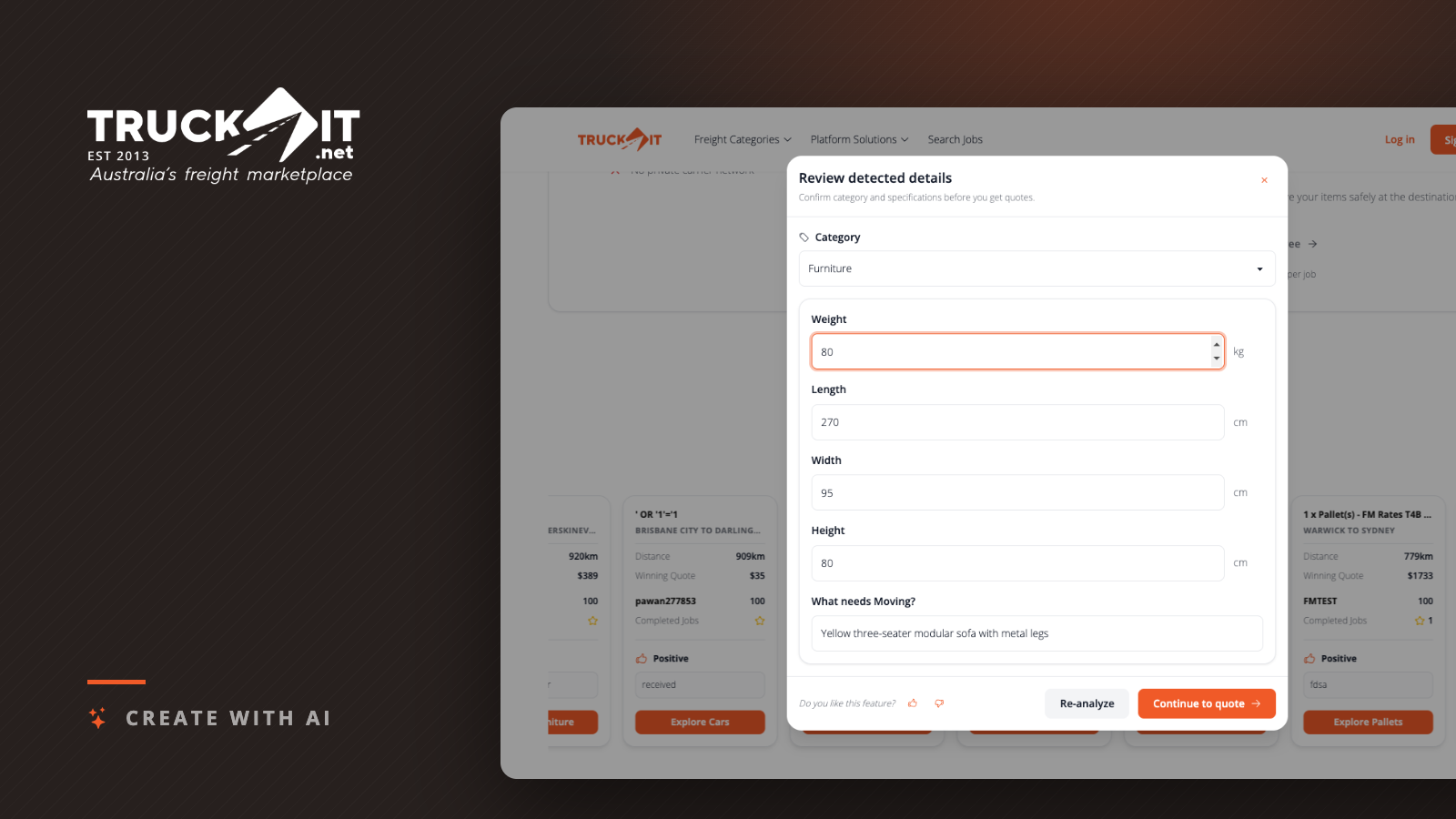
News · Product Update Your freight quote now starts with a photo Create with AI is live on Truckit. Photograph what you are moving and the listing fills itself in. TK Truckit Australia's freight marketplace 14th of September 2026 · 5 min read Take a photo of the thing you need moved. That is now enough to start a freight quote. Create with AI is live on Truckit. Upload a picture of your couch, your dresser or your pallet of stock, and Truckit reads the image, works out which freight category it belongs in, and estimates the weight and dimensions. […]
News · Managed Services Freight is the friction your business doesn’t need. Here’s how managed services remove it. Why more Australian businesses are handing their freight to a managed service, and what they get back. KD Kieran Dawkins Head of Managed Services · Truckit.net 18 July 2026 · 5 min read While most businesses can understand a freight rate card, a lot aren’t quite aware of the true freight costs to their business. Everything from the time it takes to procure and manage carriers, to increasing capacity at short notice, through to chasing ETAs, reconciling invoices, misaligned payment terms and […]

We’ve been busy building behind the scenes, and a wave of new features have just rolled out. Most of it points the same way: putting AI to work on the parts of freight that used to eat your time. Searching for jobs, writing your profile, matching the right provider to the right load. Here is what is live now, and what we are working on next. You can now find freight jobs just by asking Type "find container jobs within 100km of Maryborough" into the Search Jobs page, and Truckit knows exactly what you mean. No filters to set, no […]
